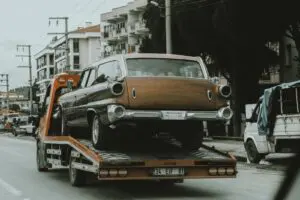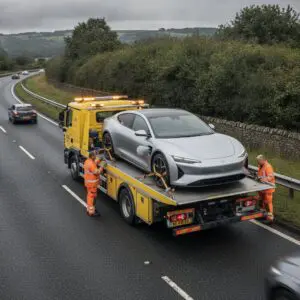
Here is the thing most classic car transport guides skip. A car that is over 40 years old is exempt from the annual MOT, but GOV.UK is explicit that the exemption does not remove your duty to keep it roadworthy — and using a vehicle in a dangerous condition still carries a fine of up to £2,500 and three penalty points. That single line is the reason so many owners in Stoke-on-Trent call us instead of turning the key on something that has been sitting in a garage since 2019.
Classic car transport means moving a classic on a flatbed rather than driving it, so all four wheels stay off the road and no mileage is added to the odometer. It suits cars that are undriveable, freshly restored, mileage-sensitive, or simply too valuable to risk on a long motorway run.
By the Fast Track Recovery team · Published 20 August 2026 · Updated 20 August 2026
What Classic Car Transport Actually Means
Classic car transport is not recovery. Recovery is what happens when something goes wrong at the roadside. Transport is planned — you know the pickup address, the delivery address and roughly when you want it done, and the vehicle is moved on a flatbed as a scheduled job.
The jobs we see most often on classics fall into a handful of patterns:
- A car bought at auction or from a private seller that needs collecting from the other end of the country
- A restoration project moving from a driveway or storage unit to a specialist workshop
- A finished car going to a show, a photoshoot or a new owner without adding show-day miles
- A car coming out of long-term storage that has not been started, taxed or insured for years
- A sale where neither buyer nor seller can realistically drive it themselves
What links all of them is that driving the car is either impossible or a bad idea. Once you accept that, the question stops being “how do I get it there” and becomes “what is the safest way to lift it and put it down again.”
The MOT Exemption Trap Nobody Mentions
The 40-year rolling exemption is one of the best things about owning a classic in the UK, and it is also where owners get caught out. Two details in the GOV.UK guidance matter enormously if you are deciding whether to drive or transport.
First, the exemption only applies if no substantial changes have been made to the vehicle — the guidance names replacing the chassis, body, axles or engine in a way that changes how the vehicle works. Plenty of restored cars quietly fail that test.
Second, and more importantly: you do not need an MOT, but you must still keep the car in a roadworthy condition. No annual test means nobody has independently checked the brakes, tyres or steering. On a car that has sat on the same set of tyres for six years, that is not a paperwork issue — it is a braking distance issue.
An MOT exemption removes the test, not the responsibility. If you would not be comfortable being tested on it tomorrow, do not drive it a hundred miles today.
This is the honest reason to book transport for a car coming out of storage. Not because it looks nicer arriving on a truck, but because the first thirty miles after a long lay-up are the ones most likely to find a seized caliper or a perished brake hose.
Open Flatbed Or Enclosed? The Honest Answer
Search classic car transport and almost every result will steer you towards enclosed transport as the premium option. It is a real product and for a genuinely rare, concours-condition or six-figure car it is the right call.
We do not run an enclosed transporter, and we are not going to pretend otherwise. What we run is a flatbed, and for the large majority of UK classic moves — a running MGB going to a show, a Triumph shell going to a bodyshop, a project Escort moving between lock-ups — a flatbed does the job that actually matters.
Here is what most guides get wrong. They frame the decision as open versus enclosed, when for most owners the real decision is driven versus not driven. Getting the wheels off the ground is the step that eliminates road miles, stone chips from your own wheels, clutch wear, overheating risk and the chance of a breakdown halfway. Whether there is a roof over the deck is a second-order question.
If your car is a concours winner or a rare, high-value collector piece heading to a major auction, book a specialist enclosed carrier. If it is a well-loved classic, a restoration project or a mileage-sensitive car that simply should not be driven, an open flatbed is the sensible, proportionate choice.
How A Classic Is Secured On A Flatbed
Loading a classic is not the same as loading a modern hatchback, and the differences are where damage happens if a driver is careless.
The principles that matter:
- All four wheels off the ground. No towing, no dollies, no drive wheels turning. Nothing wears and nothing registers on the odometer.
- Wheel straps, not chains on the chassis. Straps over the tyres let the suspension work normally in transit. Chains hooked to suspension arms load components that were never designed as tie-down points.
- Soft loop straps near paint and chrome. Chrome bumpers, wire wheels and original paint do not survive a metal hook rubbing against them for two hundred miles.
- Gentle approach angles. Low ground clearance and long front overhangs are the classic-car loading problem. A shallow ramp angle and a slow winch are how you avoid grounding a splitter or a sump.
- Correct tension. Over-tightened straps compress suspension and can distort older bushes. Under-tightened straps let the car move. There is a middle ground and it is learned, not guessed.
Our vehicle transportation service handles classic and specialist cars specifically on flatbed for this reason — all four wheels off the ground throughout, with no strap contact against bodywork or chrome. If you want the mechanics of flatbed loading explained in more detail, we have written a full guide to why flatbed is the safest way to move a car.

What Classic Car Transport Costs In The UK
Most UK vehicle transport companies quote on a per-mile basis, with the rate per mile falling as the distance grows, and enclosed transport carrying a clear premium over open transport. That is worth knowing because it means two quotes for the same job can be structured completely differently, and the cheaper headline rate is not always the cheaper job.
We do not quote per mile. We agree a single fixed price for the job before anything moves, based on the route, the vehicle and the loading method. There is no per-mile meter running and no adjustment at the far end. For a classic move, the variables that shift the price are the ones you would expect:
- Distance and route — a Stoke-to-Cardiff run costs more than a Stoke-to-Stafford run
- Whether the car runs and drives or needs winching onto the deck
- Access at both ends — a tight lock-up or a gravel paddock takes longer than a driveway
- Ground clearance and whether extra ramp work is needed
- Timing — a flexible date is cheaper than a same-day collection
If you want a broader picture of what recovery and transport work costs in this part of Staffordshire, our vehicle recovery cost guide breaks the numbers down properly.
Need A Classic Moved?
Fast Track Recovery moves classics, non-runners and project cars on a flatbed across Stoke-on-Trent and the UK. Fixed price agreed before we move.
When To Book Transport Instead Of Driving It
Sometimes driving the car is genuinely the better option. If it is taxed, insured, freshly serviced and you are going twenty miles on a dry Sunday, drive it and enjoy it. That is what it is for.
Book transport when any of the following are true:
- The car has been off the road long enough that you do not know the condition of the brakes, tyres or fuel
- It is not taxed, not insured, or you cannot prove it is roadworthy
- Mileage matters — either for value or because you are on a limited-mileage classic insurance policy
- It is a non-runner, a rolling shell or mid-restoration
- The journey involves significant motorway mileage the car was never designed for
- You are collecting from an auction site or a seller who wants it gone today
That last one comes up more than people expect. We have collected a non-runner from BCA Birmingham and delivered it to the buyer’s home in Newcastle-under-Lyme the same afternoon, and moved a Ford Mustang from a Stoke seller to a Cardiff buyer when neither side could arrange collection, with photo confirmation to both parties. For longer runs, our long distance recovery guide covers how cross-country moves are planned.
Have the pickup and delivery postcodes, the make, model and year, whether it runs and drives, ground clearance if it is low, and any access restrictions at either end. Five minutes of detail on the phone is the difference between an accurate fixed price and a rough estimate.

Frequently Asked Questions
Is open or enclosed transport better for a classic car?
Enclosed transport is better for genuinely rare, concours-condition or very high-value cars, because it adds protection from weather, road debris and public view. For most classics, the meaningful gain comes from having all four wheels off the ground on a flatbed rather than driving. If your car is a show-standard or auction-grade collector piece, use a specialist enclosed carrier. Otherwise, an open flatbed is a proportionate choice.
Does transporting a car add mileage to the odometer?
No. On a flatbed all four wheels are off the ground, the wheels do not turn and the drivetrain is not running, so the odometer does not move. This is the single biggest reason mileage-sensitive and limited-mileage-insured classics get transported rather than driven. Towing with two wheels on the road is a different matter — that can register mileage and adds wear.
Can a classic car be transported if it does not run?
Yes. Non-runners, rolling shells and mid-restoration projects are routine flatbed work. The vehicle is winched onto the deck rather than driven on, and secured in the same way. Let us know when you call that it is a non-runner, because it changes the loading method and the time on site, and therefore the fixed price we quote.
Do I need insurance to have my classic car transported?
The vehicle does not need its own road insurance to be carried on a flatbed, which is why transport is the usual route for cars that are untaxed, uninsured or SORN. The transport itself should be covered by the operator’s goods-in-transit cover — ours is fully insured. If your classic is on an agreed-value policy, it is worth telling your insurer the car is being moved, as some policies have specific conditions.
Moving A Classic In Stoke-On-Trent Or Anywhere In The UK
Classic car transport is one of the few jobs where the cheapest option and the right option usually agree. Getting the wheels off the ground costs less than a botched drive home, and considerably less than replacing a brake line that let go on the A500 because nobody had checked it since 2019.
We move classics, restored cars, non-runners and project vehicles from Stoke-on-Trent and across the UK on a flatbed, with a fixed price agreed before we set off. Tell us what it is, where it is and where it needs to be, and we will tell you exactly what it costs.