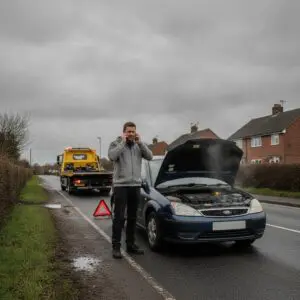
DVSA figures analysed by road safety campaigners show that 2,152,849 vehicles failed their MOT on tyre defects in 2023–24 — up from 1.83 million four years earlier — and 36% of those, more than 750,000 vehicles, had already been given a tyre advisory at a previous MOT and ignored it. A tyre blowout at speed almost never comes out of nowhere. It comes out of something a garage already flagged.
In a tyre blowout, do not brake. Grip the wheel firmly with both hands, hold your line, and ease off the accelerator so the car slows gradually. Steer smoothly to the hard shoulder or nearest safe place, put your hazards on, get out on the side away from traffic, and call for recovery.
By the Fast Track Recovery team · Published 25 August 2026 · Updated 25 August 2026
What To Do When A Tyre Blows Out
A blowout on a dual carriageway is loud, sudden and physical. The car pulls hard towards the failed corner and the steering goes vague. What you do in the next four or five seconds decides how this ends.
1. Grip the wheel and hold your line
Both hands, firm grip. The car will try to pull towards the blown tyre — resist it with steady pressure rather than a sharp correction. A snap of opposite steering is what turns a blowout into a spin.
2. Keep off the brake
This is the one that matters most and the one that goes against every instinct. Braking throws weight forward and sideways onto a wheel that has no support left, which is exactly how a car gets unsettled at speed.
3. Ease off the accelerator
Lift smoothly rather than snapping off the throttle. The drag from the destroyed tyre will slow the car on its own, and it slows it faster than you expect.
4. Signal and drift left
Once speed is down and the car feels settled, indicate and move across in small, smooth inputs. Aim for the hard shoulder, an emergency area, a slip road or the next exit — whatever is closest and safest.
5. Stop, hazards on, get out safely
Pull as far left as you can. Hazard lights on. If you are on a motorway or fast dual carriageway, leave the vehicle by the left-hand doors, get behind the barrier, and stand back from the car rather than beside it.
6. Call for help, not for a wheel brace
Then call recovery. Not because changing a wheel is difficult, but because of where you are standing while you do it.
Even professional tyre fitters will not work on a live hard shoulder without a protection vehicle behind them. A spare in the boot does not make the hard shoulder safe. If you are on the M6, the A500 or the A50 and your tyre has gone, the correct move is recovery, not a roadside wheel change.
Why Braking Is The Instinct That Makes It Worse
Every guide tells you not to brake. Very few explain why, and understanding it is what makes the advice stick under pressure.
A tyre is not just grip — it is structure. It holds up its corner of the car. When it fails, that corner loses both its contact patch and its support at the same moment. Brake, and you deliberately transfer weight onto the one corner least able to carry it, while the intact tyres on the other side keep gripping normally. The result is an imbalance that yaws the car.
Lifting off does the opposite. Weight stays settled, the intact tyres keep doing the work, and the drag of the flat does the deceleration for you. It feels passive. It is the single most effective thing you can do.
The reason blowouts become collisions is almost never the tyre. It is the correction.
Rear blowouts feel worse than front ones because the car starts to move around behind you rather than pulling in front of you. The response is the same. Hold the wheel, hold your nerve, lift off.
Tyre Gone And Can’t Drive?
Fast Track Recovery is on call 24/7 across Stoke-on-Trent, the A500, A50 and the M6. We’ll get you and the car off the road safely.
Blowout Or Slow Puncture? Why It Changes What You Do Next
These get lumped together and they should not be. They are different failures with different answers.
A slow puncture loses pressure over hours or days. You notice pulling to one side, a soft feel in the steering, or a tyre pressure warning light. The car is still controllable and you usually have time to get to a tyre centre under your own steam — provided you go straight there and keep your speed sensible.
A blowout is a structural failure. The tyre is gone: sidewall torn, casing shredded, often taking the wheel rim and sometimes an arch liner or a wheel arch with it. There is no driving on. There is no repairing it either.
A blown tyre cannot be repaired. Puncture repairs are only viable for small punctures in the tread area within specific limits; sidewall damage and blowout damage put a tyre permanently beyond repair. Anyone offering to patch a blowout is not doing you a favour.
Driving even a short distance on a fully deflated tyre means the rim is running on tarmac. On low-profile tyres and alloy wheels that turns a tyre bill into a tyre-plus-wheel bill very quickly. It is one of the main reasons we load blowout jobs onto a flatbed rather than towing them.
Run-Flats And Space Savers Change The Answer
What is fitted to your car changes what you can do after a blowout, and a lot of drivers do not know which of these they have until it matters.
- Full-size spare. Increasingly rare on new cars. If you have one, and you are somewhere genuinely safe to work, you can fit it and drive on normally.
- Space saver. The narrow skinny wheel. The RAC advises you should not exceed 50 mph on one, because it has less grip and is more liable to skid or spin under heavy braking. It is a get-to-the-tyre-shop tool, not a spare wheel.
- Run-flat tyres. Reinforced sidewalls let you keep going at reduced speed for a limited distance after losing pressure — check your handbook for your car’s specific limits. That is for a puncture. A genuine blowout on a run-flat is still a blowout.
- Sealant and compressor kit. Fine for a nail or a screw in the tread. Completely useless on a shredded sidewall, which is what most people actually have when they open the boot.
The honest summary: a sealant kit or a space saver solves a puncture. Neither solves a blowout. If the tyre has come apart, the car needs moving.
When A Tyre Blowout Needs Recovery, Not A Roadside Fix
Our breakdown recovery service lists tyre blowouts where the vehicle cannot be driven safely as a standard call-out, and it is one of the more common reasons we get called at night. Recovery is the right answer when:
- The tyre has come apart rather than simply deflated
- You are on a motorway, a hard shoulder, a smart motorway with live lanes, or an unlit dual carriageway
- The rim, arch liner or bodywork is damaged as well as the tyre
- You have no usable spare, or only sealant, or only a space saver and a long way to go
- There is nowhere genuinely safe to kneel down beside the car
- It is dark, raining, or you are simply not confident doing it
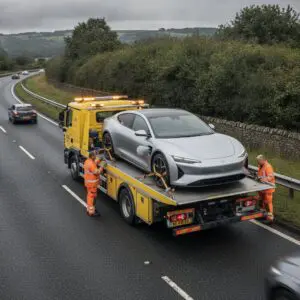
A recent example from our own jobs list: a BMW 5 Series suffered a motorway blowout at an M6 junction on a low-profile tyre and was undriveable. We used a flatbed specifically to avoid any further rim damage and delivered it to the customer’s preferred tyre centre. That is the shape of most of these calls — the tyre is a small problem and the wheel is the expensive one.
We are a recovery and transport operator, not a mobile tyre fitter. We do not sell roadside tyre replacement. What we do is get you and the vehicle off a live road and to a tyre centre or garage of your choosing. If you have a serviceable spare and just want a hand fitting it somewhere safe, say so when you call and we will tell you honestly whether that is sensible where you are.
Motorway procedure beyond the tyre itself — where to stand, when to call 999, how emergency areas work — is covered in our guides to breaking down on the M6 near Stoke-on-Trent and motorway recovery.

Frequently Asked Questions
What should you not do during a tyre blowout?
Do not brake, and do not make a sharp steering correction. Both destabilise a car that has just lost support at one corner. Braking shifts weight onto the failed wheel; a snap of steering can start a spin. Keep both hands on the wheel, hold your line, and lift off the accelerator so the drag of the flat tyre slows you gradually.
Can a blown tyre be repaired?
No. A blowout is a structural failure of the tyre, usually involving the sidewall or the internal casing, and that damage is permanently beyond repair. Puncture repairs are only permitted for small punctures within the tread area and within defined limits. A blown tyre has to be replaced, and the wheel rim should be inspected at the same time.
How fast can you drive on a space saver spare?
The RAC advises that you should not exceed 50 mph on a space saver, and the limit is usually printed on the wheel itself — always follow what your own wheel and handbook say. A space saver has less grip and is more liable to skid or spin under heavy braking, so it is designed to get you to a garage or home after a puncture, not to complete a journey.
What is the most common cause of a tyre blowout?
Underinflation is the most commonly cited cause, because a soft tyre flexes more, builds heat and eventually fails structurally. After that come worn or ageing tyres, impact damage from potholes and kerbs, and overloading. All four are things a pressure check and a monthly look at your tyres would catch — which is exactly why the DVSA advisory figures above are so striking.
The Point Everyone Misses About Blowouts
A blowout is treated as bad luck, and the DVSA numbers suggest that most of the time it is not. Over 750,000 vehicles a year fail an MOT on tyres having already been warned about them. Tyres are checked once a year in this country and nothing chases you up in between.
Five minutes a month with a pressure gauge and a proper look at the sidewalls is the whole of the prevention. If it has already happened, though, and you are sitting on the hard shoulder of the M6 with a tyre in pieces, do not get out the wheel brace. Get behind the barrier and call us.