The average electric car in the UK now covers around 300 miles on a single charge, according to the Society of Motor Manufacturers and Traders — nearly three times the distance a typical driver travels in a week. But range isn’t the problem when an EV stops at the roadside. The real issue is how it gets moved, because an electric car cannot be towed the way a petrol or diesel car can.
Short answer: A broken-down electric car should almost always be moved on a flatbed recovery truck with all four wheels off the ground. EVs have no true neutral gear, so towing one on its wheels forces the motor to generate electricity and can seriously damage the battery and drivetrain.
By the Fast Track Recovery team · Published 11 August 2026 · Updated 11 August 2026
Why You Can’t Just Tow An Electric Car
In a petrol or diesel car, a recovery driver can put the gearbox in neutral and tow the car on its own wheels for short distances. An EV doesn’t work like that. Its electric motor is connected directly to the driven wheels, and there is no genuine neutral that fully disconnects them.
Turn those wheels while the car is being towed and the motor is forced to spin too — acting as a generator and pushing electricity back into a battery system that may be switched off and unable to manage it. Kia puts it plainly: because EVs don’t have a neutral gear, towing them on their wheels “will create a build of kinetic energy that will damage the battery,” which is why electric cars can only be towed on flatbed trucks (Kia UK). Most manufacturers, from Tesla to Nissan, say the same thing in their handbooks.
What Flatbed Recovery Does Differently
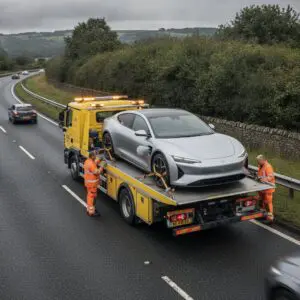
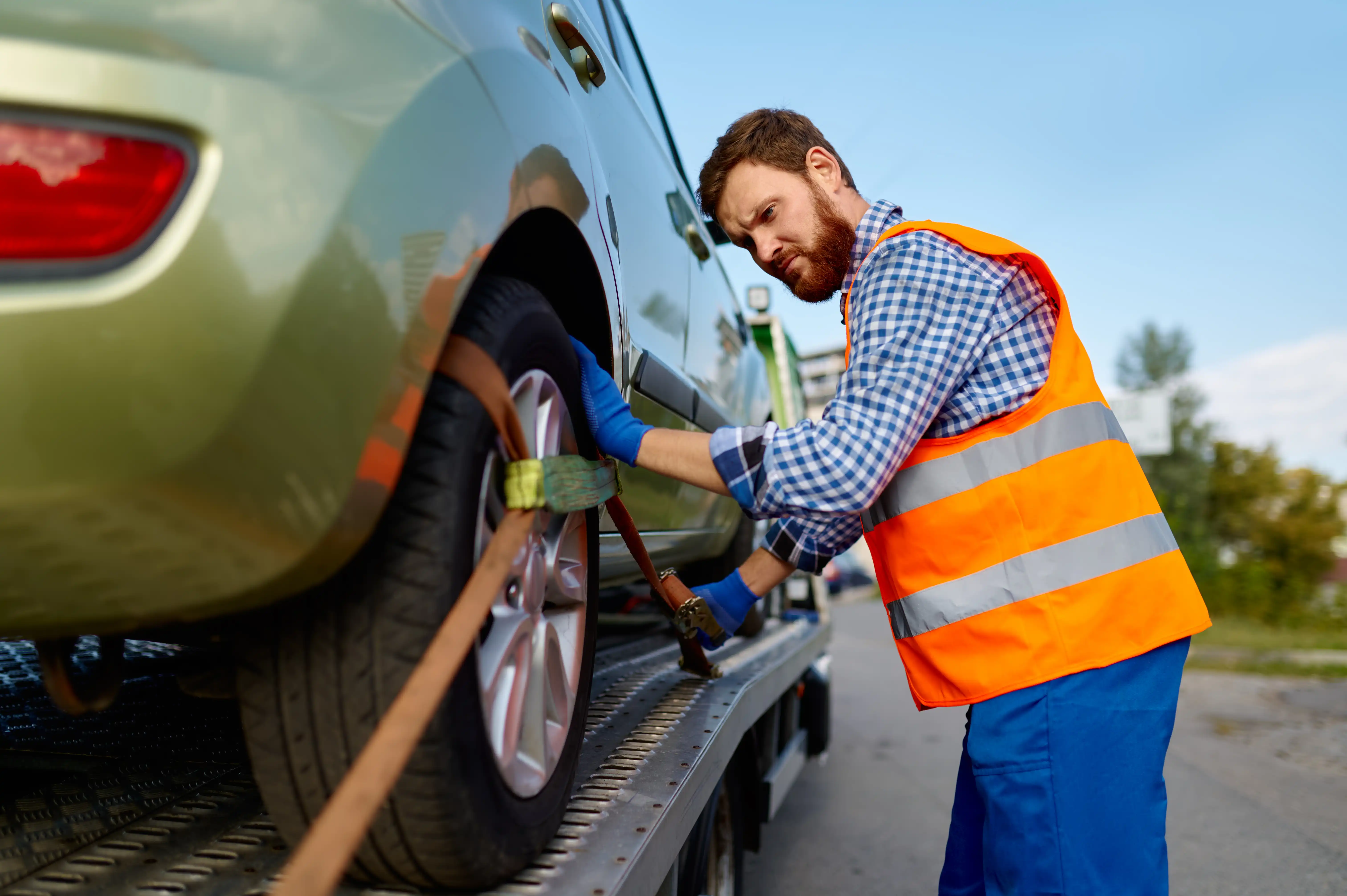
Flatbed recovery removes the risk entirely. The whole car is winched onto the level bed of the truck so all four wheels are off the ground and nothing rotates on the way to its destination. No spinning wheels means no unwanted current, no motor overspeed, and no stress on the single-speed drivetrain.
It is also simply the safest way to move a heavy, low-slung EV without scraping battery packs or bumpers. That is why our flatbed transportation service is the default for every electric vehicle we recover around Stoke-on-Trent — the car is secured flat, transported without a single wheel turning, and unloaded exactly where you need it.
Don’t Try To Jump Start Or Push It
Two instincts get EV drivers into trouble at the roadside, and both can cause expensive damage.
- Jump starting: An EV runs on a high-voltage battery pack — typically 400 to 800 volts — that powers the drivetrain, plus a separate 12-volt battery for lights and electronics. You cannot jump start the high-voltage system the way you would a conventional car, and tampering with it can be dangerous. If only the 12-volt battery is flat, it needs handling to the manufacturer’s instructions.
- Pushing: Because the motor and battery are linked to the wheels, pushing an EV any real distance can generate current and cause damage — the same reason it can’t be flat-towed.
If your EV has simply run out of charge, some recovery providers carry portable boost chargers that can give you enough range to reach a charge point. If not, the car goes on the flatbed.
Electric Car Stuck At The Roadside?
Fast Track Recovery runs flatbed recovery trucks 24/7 across Stoke-on-Trent — the safe way to move any EV.
What To Do If Your EV Stops
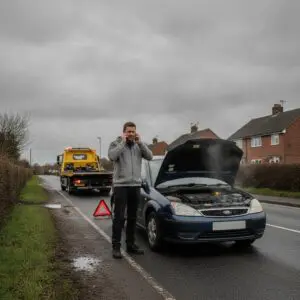
If your electric car loses power or won’t drive, the roadside steps are much like any breakdown, with the recovery method being the key difference:
- Pull over somewhere safe, ideally well off the road, and switch on your hazard lights.
- Power the vehicle down to protect the remaining auxiliary systems.
- Get yourself and any passengers to a safe spot away from traffic.
- Call a recovery service that has flatbed capability and can handle EVs — and tell them it’s electric when you call.
A non-start isn’t always the battery, either. If you’re not sure whether it’s a flat 12-volt battery, a charge issue or something else, our guide on what to do when a car won’t start walks through the common causes, and you can read more about how loading works in our flatbed recovery explained guide.
Does Recovering An Electric Car Cost More?
Not necessarily. The recovery method is different, but once the car is secured on the bed the job is much like any other breakdown. What can nudge the price is the extra care an EV needs — correct loading, awareness of the high-voltage system, and sometimes a longer run to a charge point or specialist rather than the nearest garage.
Weight matters too. Electric cars are heavier than the equivalent petrol model because of the battery pack, so operators need trucks rated to carry them safely — something any reputable local recovery service will already have covered. For a full breakdown of what UK recovery typically costs, see our vehicle recovery cost guide.
Electric Car Breakdown FAQs
Can you tow an electric car if it breaks down?
Yes, but only on a flatbed with all four wheels off the ground. Towing an EV on its wheels risks serious damage to the motor and battery, so conventional rope or suspended tows are not suitable.
Why can’t electric cars be towed on their wheels?
An EV’s motor is connected directly to the wheels with no true neutral gear. Spinning the wheels forces the motor to act as a generator and feed current back into a battery that can’t safely absorb it.
Can you jump start an electric car?
You cannot jump start the high-voltage battery that drives an EV. A flat 12-volt auxiliary battery is a different matter, but it must be handled to the manufacturer’s guidance — when in doubt, call recovery.
Can you push an electric car to safety?
Only a very short distance, if at all. Pushing an EV turns the wheels and can generate current through the drivetrain, so it’s better to get it onto a flatbed than to push it any real distance.
An electric car breakdown isn’t more dangerous than any other — it just needs the right truck. Make sure whoever you call can put yours on a flatbed.
About the author: The Fast Track Recovery team provides 24/7 breakdown, accident and flatbed recovery across Stoke-on-Trent, handling everything from EVs and motorcycles to vans and long-distance transport.